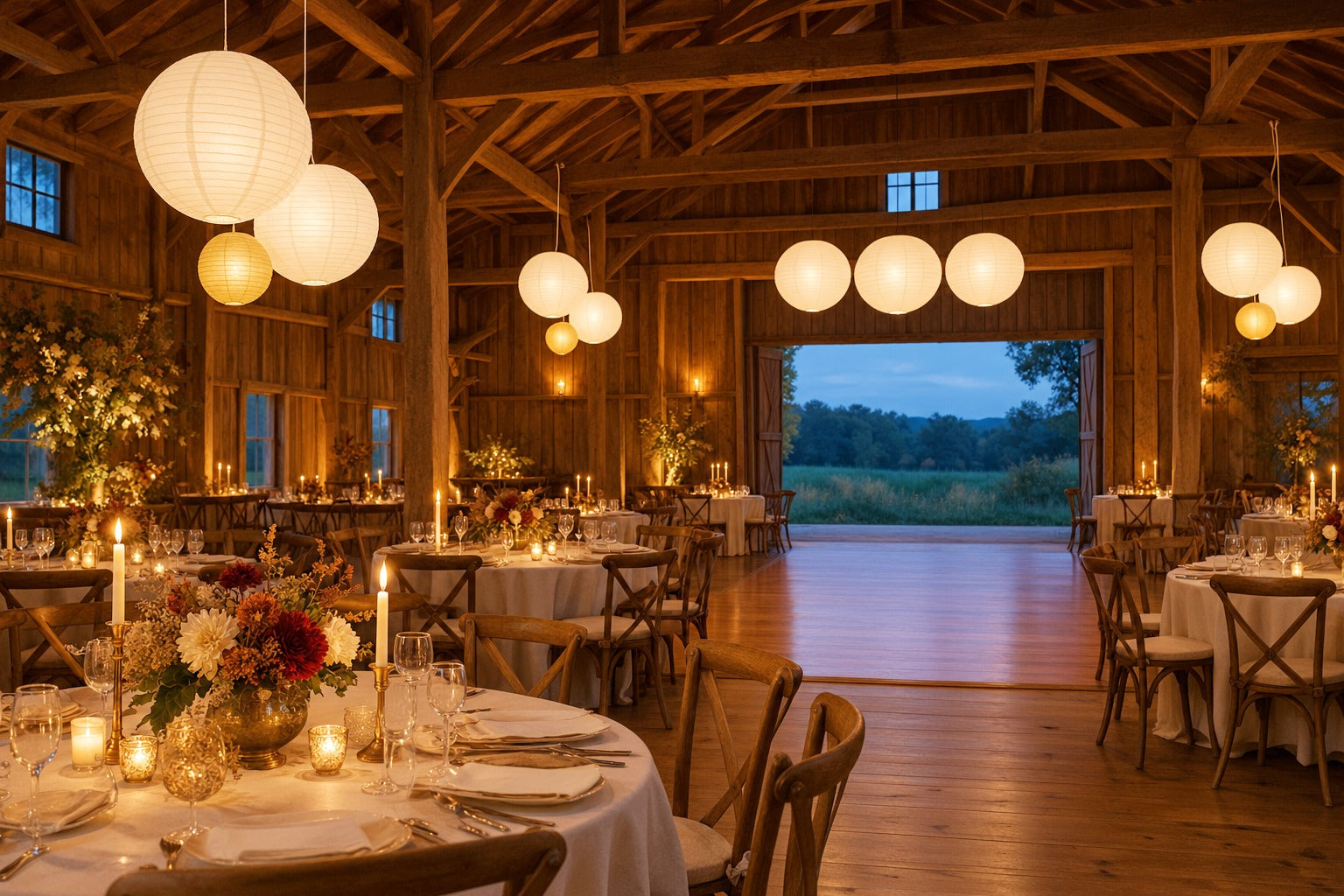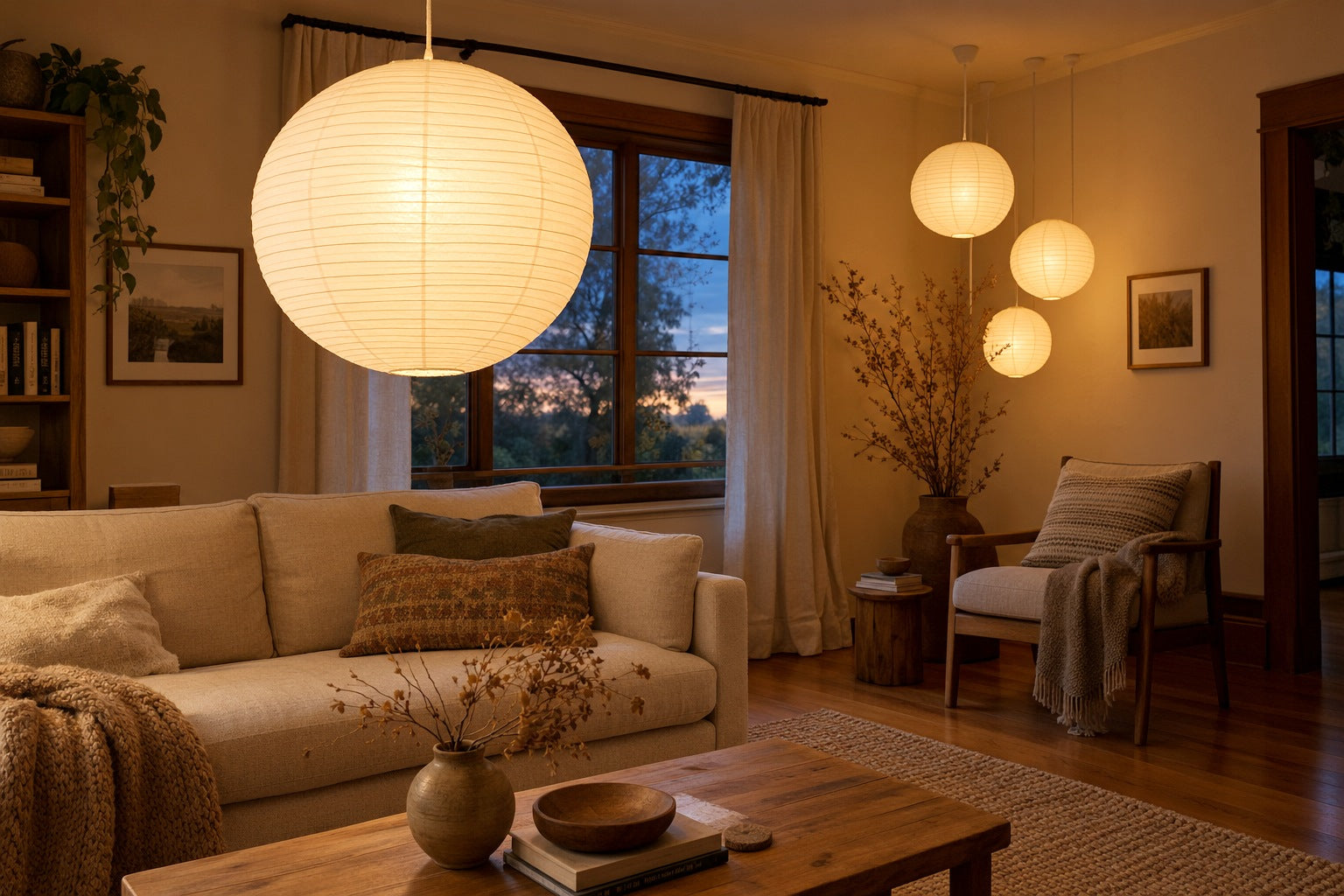













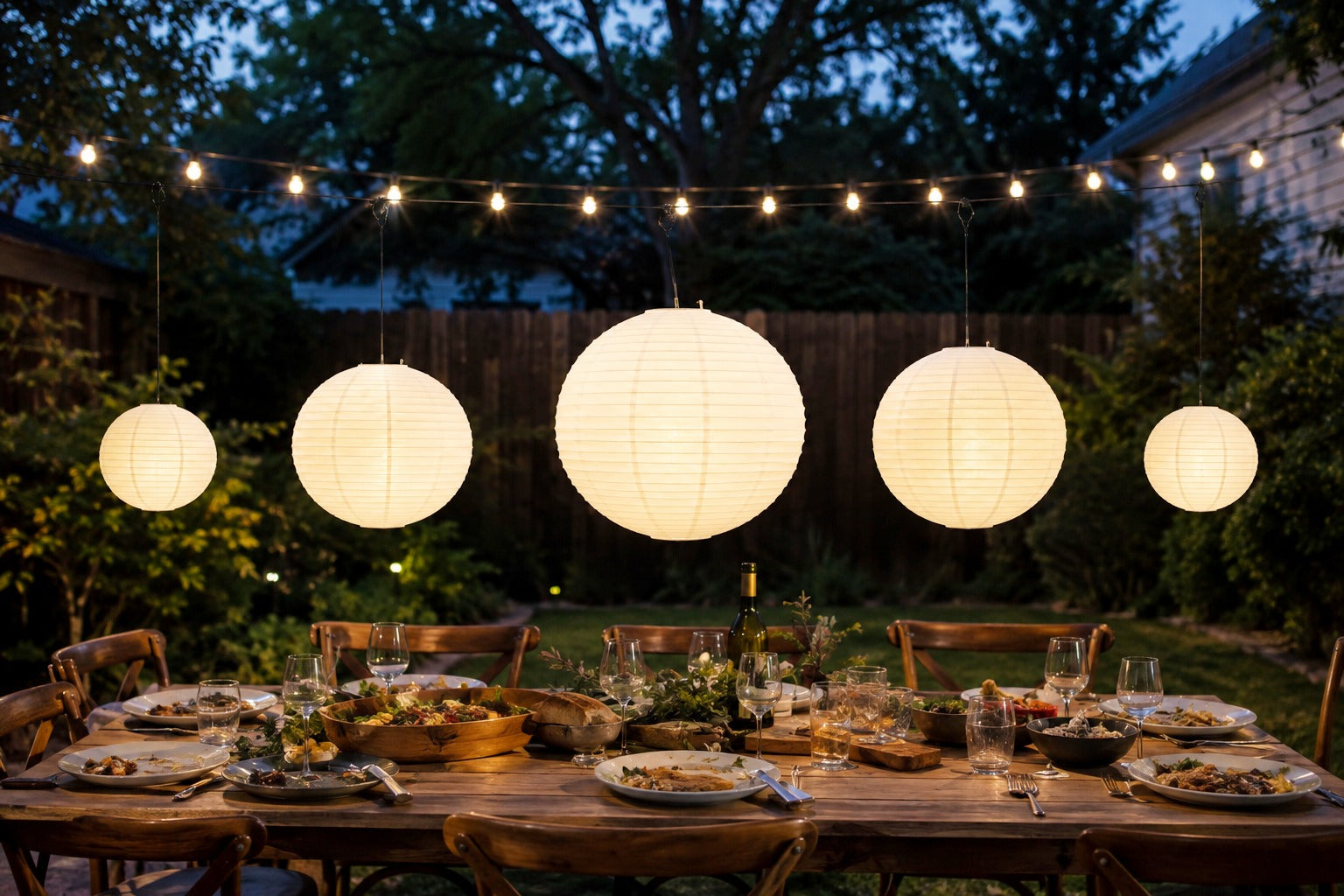


The difference between a backyard that looks decorated and one that looks finished is almost always hang height. Most people string lights across the whole yard, hang everything at roof level, and end up with a lit yard and a dark table. The table is where people actually sit for four hours.
This is the setup we get asked about more than any other, and it comes down to three numbers: how low, how many, and how far apart. Here they are, with real counts for a 6-foot table, an 8-foot table, and a long run of two pushed together — plus what it costs, which is less than most people expect.
Hang lanterns 30 to 36 inches above the table, not the ground
This is the number that matters and it is lower than instinct says. Measure from the tabletop, not the grass. A standard table is 30 inches tall, so 30 to 36 inches of clearance puts the bottom of your lanterns five to five and a half feet off the ground.
That feels aggressively low when you are standing next to it holding a lantern. It looks right the second people sit down. Seated eye level is around 48 inches, so the lanterns sit just above the sightline across the table — close enough to read as one lit room, high enough that nobody is looking through them at the person across from them.
The one rule that goes with it: this only works over the table. The moment your run crosses a walkway, a doorway, or the path to the grill, you need seven feet of clearance to the bottom of the lantern. Plan the low section and the high section as two different things rather than splitting the difference and getting neither.
How many lanterns for your table
Space lanterns 16 inches apart, center to center. Closer and they read as a solid mass; farther and they read as scattered. If you want them denser, drop to 14 inches and add one more.
A 6-foot table is 72 inches, which gives you five lanterns. An 8-foot table is 96 inches and takes seven. Two 8-foot tables pushed end to end come to 16 feet and take thirteen, which sounds like a lot until you price it.
Mix three sizes and put the largest in the middle. On a 6-foot table that is one 16-inch in the center, a 12-inch on either side, and an 8-inch at each end. That arrangement costs about seven dollars in white lanterns — the 8-inch is $1.07, the 12-inch $1.53, the 16-inch $1.87. Uniform sizing is the more common mistake; it flattens out and looks like a row of the same object rather than a centerpiece.
For the 8-foot table, step the middle up to an 18-inch, move the 16-inch pair out to flank it, and keep a 12-inch and an 8-inch at each end. Eleven dollars and change.
The light inside costs more than the lantern
This surprises people and it is worth saying plainly: a 12-inch lantern is $1.53 and the light that goes in it is $4.95. Budget accordingly — for a five-lantern table you are looking at about seven dollars of paper and about twenty-five dollars of light, so roughly $32 all in. The 8-foot, seven-lantern version lands around $46.
The default is the MoonBright 12-LED remote light in warm white at $4.95. It hangs inside the lantern, runs on batteries so there is no cord to hide, and the remote means you are not reaching up into five lanterns one at a time when the sun goes down. It is back in stock this week.
For 16-inch lanterns and up, the Omni360 at $7.96 is the better call — it throws light in every direction instead of down, so the whole sphere glows evenly instead of showing a bright spot at the bottom. On a 12-inch you will not see the difference. On an 18-inch you will.
If you are lighting a dozen or more, the six-pack of LED disk lights works out to about $3.66 each and is the cheapest honest way to do volume. And for texture rather than illumination, a set of fairy wire lights coiled inside a lantern gives a scattered, glittery look instead of a single warm globe. These run cool white rather than warm, so they read crisp and sparkly next to the warmer lanterns — a deliberate contrast, not a match. The weatherproof version at $4.89 has a built-in timer, which matters more than it sounds like it does when the setup is staying up all weekend.
Run a guide wire before you hang the string lights
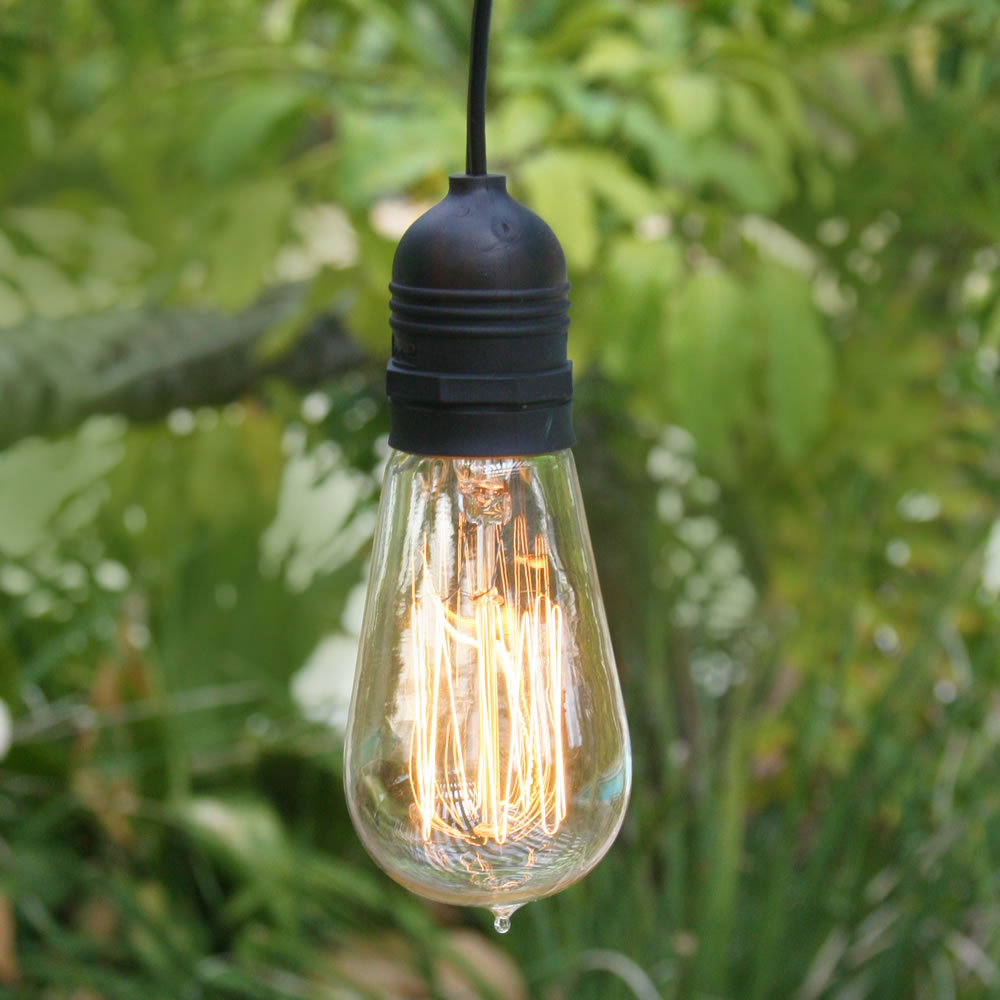
The most common failure in a backyard lighting setup is a string light cord that sags into a smile by the second night. Commercial cord is heavy — that is why it lasts — and over a long span it will droop under its own weight without something carrying the load.
Run a stainless steel guide wire first and tension it, then thread the wire through the hanging holes and loops built into each socket as you go. A 60-foot kit is $6.83 and includes the screw clamps for tensioning. It is the cheapest item in the entire setup and it is the one that decides whether the thing still looks good on Sunday.
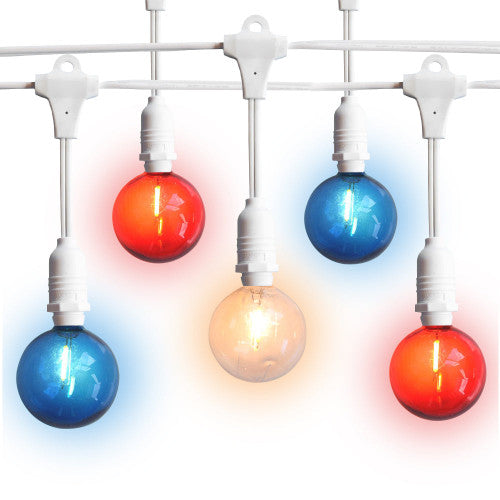
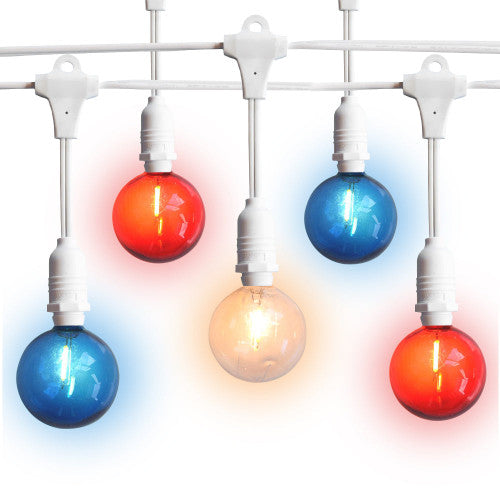
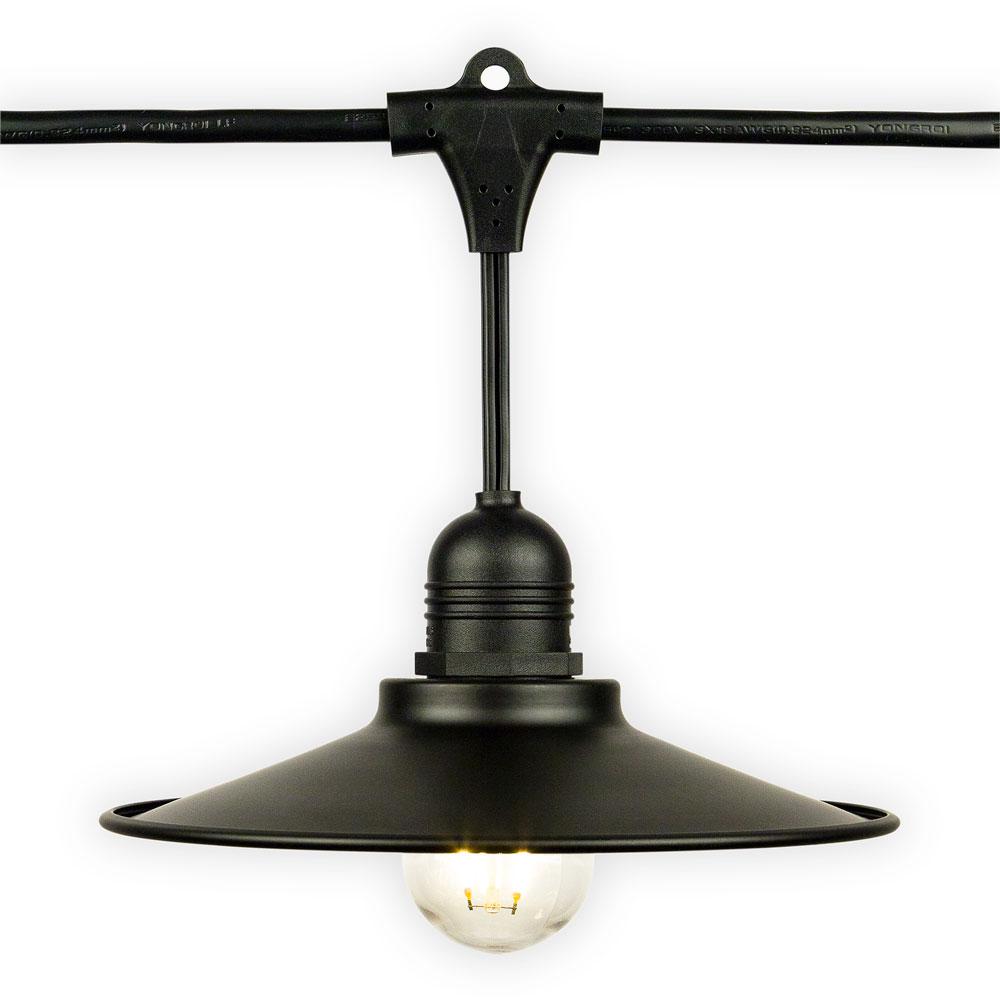
For sizing the run itself: a 10-socket commercial string light set covers 21 feet, which handles one side of a patio or a single run over a table. The 24-socket set is 54 feet and will cross most yards or do a doubled-back zigzag over a seating area. Sockets sit 24 inches apart on both, so you can count sockets to estimate coverage before you buy.
Paper or nylon depends on how long it stays up
Paper is the better-looking material and it is about half the price. For a Saturday evening, a covered patio, or anything coming down the next morning, paper is the right answer and always has been — it takes light beautifully and nothing else glows quite the same way.
Nylon earns its premium on time and weather. If the setup is going up Friday and coming down Monday, if there is dew in the mornings, or if the forecast is doing that late-August thing where a clear afternoon turns into a twenty-minute downpour, use shimmering nylon instead. It is double-ribbed, holds its shape through damp, and at $2.99 for a 12-inch it is not a big step up.
The practical version of this rule: paper over the table under a pergola, nylon on the exposed run out to the fence.

A Labor Day weekend setup, start to finish
Say you have an 8-foot table on an open patio and people arriving Saturday at five.
Seven lanterns over the table at 32 inches of clearance, one 18-inch in the center stepping down to 8-inch at the ends, each with a warm-white remote light inside. One 21-foot string light run along the fence line at seven feet, on a guide wire, for the ambient layer that keeps the rest of the yard from going black. Turn the table lanterns on at dusk and leave the fence line on a timer.
That is about $46 of lanterns and lights over the table, plus the string light set. It takes under an hour if the guide wire goes up first, and closer to two if it does not.
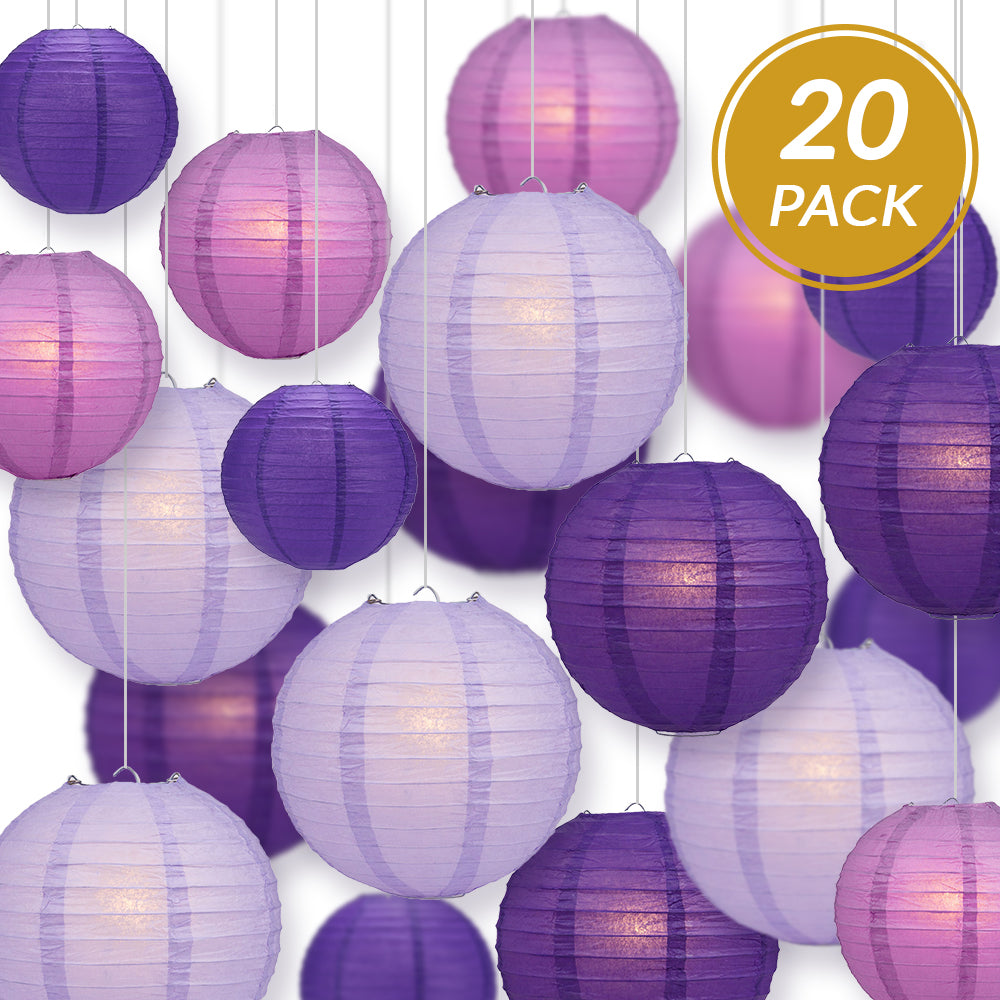
If you want the late-summer version rather than the all-white version, swap two of the white lanterns for persimmon orange at $1.53 and gold at $2.08. It reads as end-of-summer rather than Halloween, and it gives you something that carries through September without redecorating.
Common questions
How high should paper lanterns hang over a dining table?
Thirty to thirty-six inches above the tabletop, measured to the bottom of the lantern. That is five to five and a half feet off the ground with a standard 30-inch table. Anywhere the run crosses a walkway instead of a table, raise it to seven feet of clearance.
How many lanterns do I need for a 6-foot table?
Five, spaced 16 inches apart center to center. Seven for an 8-foot table, thirteen for two 8-foot tables end to end.
Can paper lanterns stay outside overnight?
For one dry night, yes. Morning dew is what actually damages them, not rain — a lantern that survives a clear evening can still be soft and misshapen by 8am. If the setup stays up more than one night, use shimmering nylon instead.
Do I need electricity to light paper lanterns?
No. Battery-powered LED lights hang inside the lantern and run for several nights on one set of batteries. That is the standard way to do it outdoors, and it is why there is no cord running to your table.
What size lantern should go in the middle?
The largest one. On a 6-foot table use a 16-inch center; on an 8-foot table an 18-inch. Stepping sizes down toward the ends is what makes a row of lanterns read as an arrangement rather than a repetition.
How far apart should string lights be hung?
The sockets are fixed at 24 inches on commercial sets, so the spacing question is really about the run. Plan seven feet of clearance over anywhere people walk, and put a guide wire under any span longer than about 20 feet.
Paper Lantern Store carries the world's largest selection of paper lanterns, lights, and decor — 24 years of fast shipping from our Union City, California warehouse.