










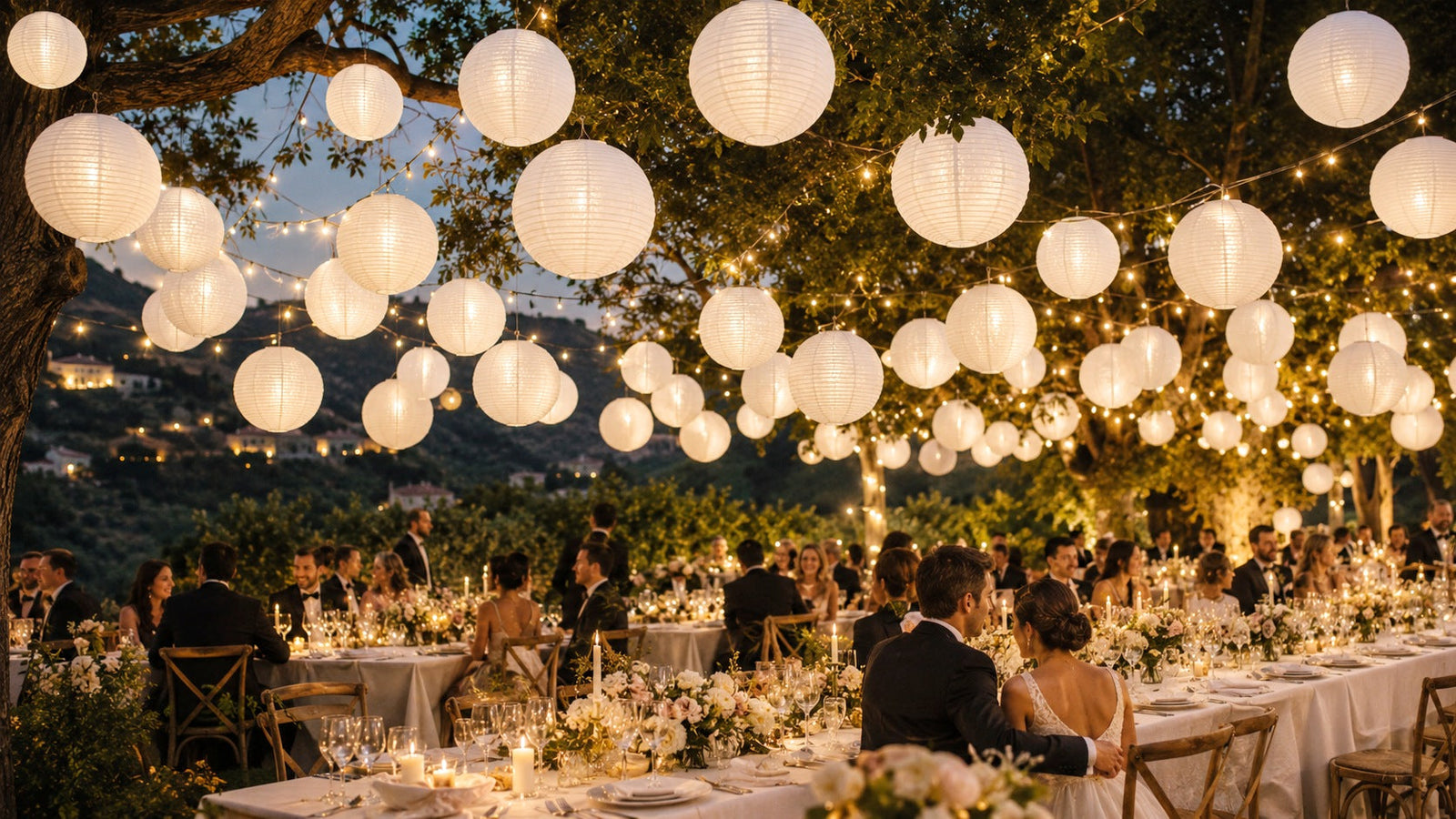

Standard paper lanterns are an indoor-and-covered-patio product. Hang one in open air for a weekend and the first heavy dew, gust, or afternoon shower will do it in. If your event is genuinely outdoors — a backyard, a vineyard, a tented reception with open sides — you want a nylon lantern, not paper. It's the same round silhouette, but built to go back in the box and come out again next year.
Here's how to tell what you actually need, and how to hang and light it so it lasts.

Why paper struggles outside
Paper lanterns are beautiful and inexpensive, and for an indoor ballroom or a covered patio they're the right call. The problem is that paper is paper. Three things end an outdoor paper lantern early:
Moisture. Morning dew is enough to soften the paper and pull the ribbing out of shape. A brief rain shower turns it translucent and floppy.
Wind. The flat panels between ribs act like little sails. A steady breeze bends the frame; a real gust folds it.
Reuse. Even if the weather cooperates, paper creases when you pack it away. It's a one-event material by design.
None of that is a knock on paper — it's just the wrong tool for open air.
What "Fine Line Nylon" actually means
Two words are doing the work here.
Nylon is the fabric stretched over the frame instead of paper. It sheds a drizzle and morning dew, doesn't wilt in humidity, holds its shape in a breeze, and wipes clean. When the event's over, it collapses flat and stores for next season — the same lantern, several weddings in a row.
Fine Line describes the ribbing. The wire ribs sit closer together than on a standard lantern, so the sphere reads smoother and rounder rather than pumpkin-paneled. Up close and in photos, it's the more polished-looking of the two.
We build them in one color — clean white — across six sizes, and we call the line Extra Sturdy because the frame is heavier-gauge than a typical decorative lantern. Browse the full range on the White Fine Line Premium Nylon Lantern collection.
Paper or nylon: which one for your event
| Standard paper lantern | Fine Line Nylon lantern | |
|---|---|---|
| Best for | Indoors, covered patios, tents with walls | Open-air: backyards, gardens, open-sided tents |
| Weather | Keep it dry | Shrugs off dew, humidity, light rain |
| Wind | Bends and folds | Holds shape in a breeze |
| Reuse | One event | Packs flat, reuse for years |
| Look | Classic, panelled | Smoother, rounder sphere |
| Price | Lowest | A little more, spread over many uses |
The honest way to think about it: paper is cheapest per event, nylon is cheapest per use. If the lanterns are going up once, indoors, buy paper. If they're going outside — or you'll want them again next summer — nylon pays for itself the second time out.
Which size goes where
The line runs from 12 to 24 inches. Mixing three sizes in a cluster looks far better than a row of identical spheres.
- 12" ($5.60) and 14" ($5.98) — the fillers. Use them in quantity to add depth around the larger lanterns.
- 16" ($7.15) and 18" ($9.58) — the everyday workhorses. If you buy one size, buy one of these.
- 20" ($12.75) and 24" ($17.95) — the anchors. One or two overhead sets the scale for the whole display.
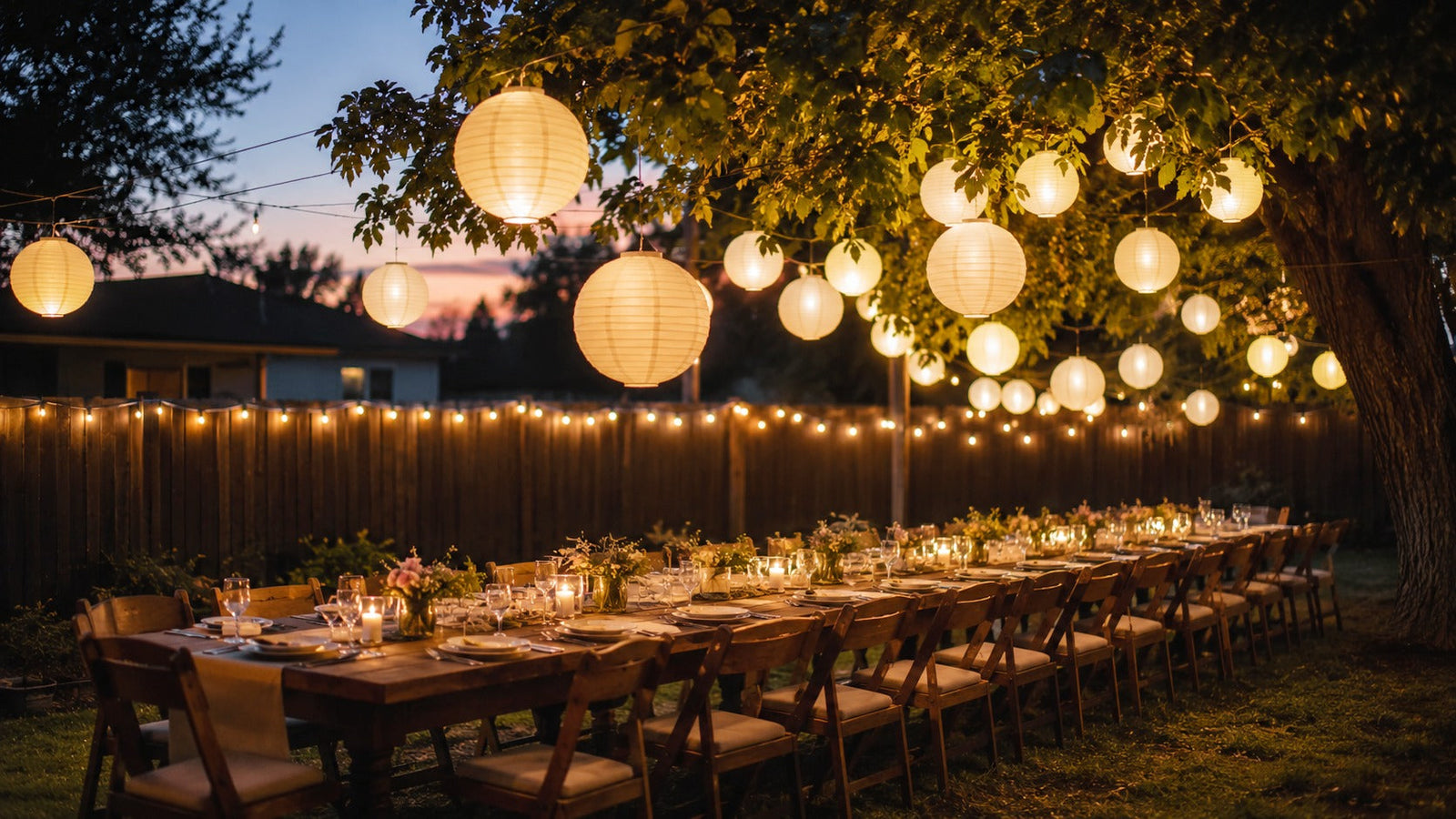
A reliable recipe for a backyard or reception canopy: a few 24" or 20" anchors, a middle layer of 16–18", and a scatter of 12–14" to fill the gaps. Odd numbers cluster better than even.
How to hang them outdoors
The wire loop at the top is for indoor decoration, not for load-bearing outdoors. A few minutes of setup keeps them where you put them.
Run a real line first. String galvanized wire or heavy fishing line between fixed points — posts, trees, the tent frame — and hang lanterns from that, not from string tied to the loop alone.
Secure with a zip tie or S-hook, not a knot that can work loose in wind. Clear zip ties disappear in photos.
Leave slack. Lanterns that swing a little ride out gusts. Lanterns pulled drum-tight take the full force and bend.
Mind the spacing. Roughly one lantern every 18–24 inches along a line reads full without looking crowded. Cluster tighter directly over a focal point — the head table, the bar, the dance floor.
Lighting them
Nylon lanterns glow beautifully lit from inside, and because the fabric is a touch more opaque than thin paper, the light reads soft rather than harsh.
Use a battery LED kit, never a heat bulb. Our warm-white MoonBright LED kit with remote ($19.66 for a 3-pack) drops in, runs cool, and switches on from across the yard — no cords, no ladders at dusk, nothing hot against the fabric. Warm white flatters skin tones in evening photos; skip cool-white unless you're after a starker, modern look.
One kit per lantern for a solid glow; every other lantern if you just want a scattered, twinkle effect.
The reuse math
This is the part that surprises people. A nylon lantern that survives one wedding survives the next one, and the one after that. Collapse them flat, keep them dry between uses, and a set bought this summer is still going in three or four years. Spread the cost across those events and the per-use price drops below what a paper lantern costs the single time you hang it.
Free shipping kicks in above $99, which most full-canopy orders clear on their own.
The fast version
- Outdoors or reusing next year → nylon. Indoors, once → paper.
- Nylon sheds dew and light rain, holds shape in wind, and packs flat to reuse.
- Mix three sizes; anchor with 20–24", fill with 12–14".
- Hang from a real wire line with zip ties, leave a little slack.
- Light with a warm-white battery LED kit — never a heat bulb.
Frequently asked questions
Can paper lanterns be used outside?
Standard paper lanterns are best kept indoors or under cover — dew, humidity, and light rain soften the paper and wind bends the frame. For open-air events, use a nylon lantern instead. Nylon sheds moisture, holds its shape in a breeze, and can be packed flat and reused.
Are nylon lanterns waterproof?
They're water-resistant, not submersible. Nylon shrugs off morning dew, humidity, and a passing drizzle without wilting the way paper does. In a sustained downpour you'd still want to bring any lanterns in — but an ordinary damp evening won't hurt them.
Can you reuse nylon paper lanterns?
Yes — that's the main reason to buy them. They collapse flat for storage and hold up over multiple events. Keep them dry between uses and a set will last several seasons.
What size lantern should I buy for an outdoor wedding or party?
Mix sizes. Use 20–24" as overhead anchors, 16–18" as the main layer, and 12–14" as fillers. A cluster of three different sizes looks fuller than a row of identical ones.
How do you light a nylon lantern?
Use a battery-powered LED kit, never a heat-producing bulb against the fabric. A warm-white LED kit with a remote drops inside, runs cool, and turns on without cords or a ladder at dusk.
Paper Lantern Store is the world's largest selection of paper lanterns, lights, and party decor — 24 years of fast, reliable shipping from our Union City, California warehouse.